SPECTACLE OF EXTINCTION
TREVOR RITLAND
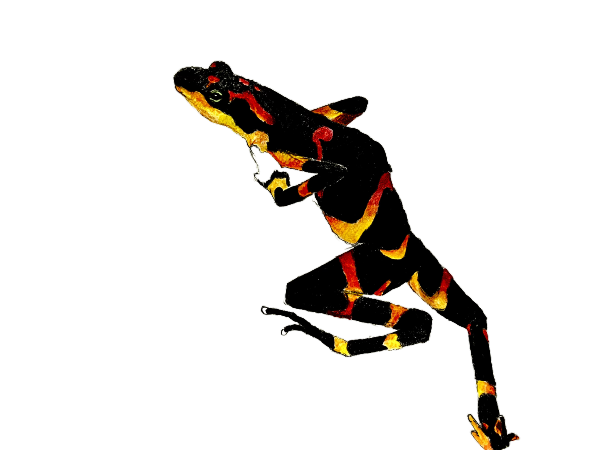
That was the year of Graciela’s second birthday, which was also the year that Clarisio Begbajji’s Spectacle of Extinction rode into town at the end of a deadly summer. Great wildfires had been burning in the oak forests of the north, and the tall walls and militarized borders did not stop the diseased smoke from spreading south and darkening the summer skies of the town at the foot of Cerro Cielo. Out of the desolation of these cataclysms arrived the Spectacle. It appeared like a carnival or a circus train that had jumped its tracks and come spilling down across the mountain ranges in a dragon-dance, twisting and turning in its serpentine course before winding inevitably to the dead fields of the Chepe Rojas farm in the shadow of the mountain. There, menageries of passengers, contractors, unionists, and acolytes spilled out from the open beds of box-trucks and swung down from the sides of steaming jalopies to pound stakes into the dust and erect big-top tents, cookhouses, calliopes, bandstands, galleries, museums, chance-games, and pagodas—all transient and portable, unfolded like the tents of an open-air church. Its affiliates flitted across the open fields like insects, busying themselves with their constructions and fabrications, and the sounds of hammers and nails and the barks of orders shouted from the rooftops of old cars rose in the air with the dust.
Before long a posse was stirred up from the patrons of Hector’s bar and from the houses on the edge of town, and the children who were intoxicated from the sweet fermentations of the school vacation trailed along behind the grown-ups, hearing only carnival and enchanted by all the associated visions of games and rides and prizes won under glittering colored lights on warm summer evenings. The crowd of the inquisitive went the long way to the old Rojas farm and saw the assembly of the Spectacle from a distance: canvas tents of different shapes and sizes like labyrinths raised above the earth, wooden stands and shops in a spontaneous arcade, galleries lined with rows of shelves for the display of who-knew-what, and above it all at the entrance to the corral a painted sign in red and black and orange letters. It read: “Clarisio Begbajji’s Spectacle of Extinction: Endlings, Endemics, and Extirpations from Every Eco-system! ‘Everything must go!’”
By the time that night fell on the southern fields of the Rojas farm, the Spectacle was ready for its formal revelation. As the evening rumbled into darkness, tales had gone through the town from the onlookers who had gathered at its fringes beneath the spotlight of the midday sun, and although the tales had grown in the telling, the Spectacle did not disappoint when the remaining townsfolk finally saw it in the flesh. The glow of it, and the cacophony, could be seen and heard through the trees from three kilometers away as their peregrinations led them to it. There had been no town meeting and no debate; they were drawn to it like moths to the moon.
Esperanza crossed its boundary with Graciela holding her right hand. It was the farthest that Graciela had ever walked, and Esperanza had asked her many times if she would rather be carried, but Graciela had responded with her familiar and urgent “No no, no!” and so by the time they reached the rim of the Spectacle’s light they were among the last to arrive from the sleeping town in the shadow of the mountain. With them had come Analínda and Fiorela. In the town at the foot of Cerro Cielo on the night the Spectacle of Extinction arrived, the winds were up and so the skies were clear, and bright silver lights of stars in their high window lit the blue-black heavens, and a full moon shone white as bone. When Esperanza and Graciela stepped across its invisible boundary into the wet grass, the string of fairy-lights that went around the border snapped to life and sudden festive music sprung from the carts and tents ahead of them; it was as if the Spectacle had been awaiting their arrival to expend its final subtleties, extensor muscles tensed and coiled, set to pounce. Graciela’s eyes lit up when the gold light fell on her, and her momentary uncertainty at the unexpected music gave way to a spell of fascination. A tall man on stilts came reeling out of one of the tents, bending to duck beneath the canvas ceiling, and bowed down to offer Graciela a flower whose petals were such a deep maroon they were almost black.
“For you, little doll,” the tall man purred. “The Chocolate Cosmos, atrosanguineus, described by Bill Hooker, 1861. Once believed to be extinct in the wild—erroneously. It lives!” And a light flashed in his eyes.
Graciela held her open hand out and took the flower by the stem, and as she did the tall man winked at Esperanza across his long thin nose.
“You say thank you, Graciela,” prompted Esperanza without taking her eyes off the man on stilts. Graciela slapped her chin instinctively and let the flower’s yellow center draw her in to its enchantment.
“From the stores of the botanist who travels in our company,” the man on stilts confided to Esperanza. “His collections are on the far side of the Spectacle. Tell him that I, Fascinarious, sent you, and ask to see the magnificent Neelakurinji of the western Ghats, which blooms just once every dozen years. That means some dogs don’t live long enough to see it in their lives!” He let out a yowl of a laugh and rose again to his full height, towering above them, and strode away in lanky steps until he was lost in the crowd. Graciela and her mother watched him go as the world of the Spectacle turned around them, and Esperanza picked Graciela up and held her close against her as they let themselves be pulled in to its orbit. Fiorela craned her neck to try to get a look at Esperanza’s eyes but the dance of lights reflected in them made all the other moods and feelings impossible to read. Before she knew that she was speaking the thought out-loud she heard herself announce: “I wish José were here.”
“Me too,” said Esperanza, and they walked together toward the bright lights at the center of the Spectacle.
It seemed that every one of their neighbors had turned out to see the strange dark carnival for themselves, and they were moving in little confluences up and down the corrals that ran between tents and booths and improvised storefronts, and Esperanza and Graciela wove among them with Fiorela and Analínda at their heels. In a chill wind, not knowing it, they wandered in a whorl toward the Spectacle’s center, sitting like a capture-spiral among the booths and marvels. Here was an exhibition of perpetual motion machines, turning over on themselves into infinity; here was a taxidermist unveiling the stuffed and mounted plastinated bodies of creatures from the wild south: jaguarundis and tapirs and kinkajous and night-monkeys hanging by their tails. Here was a museum of bones and ivory: crocodile skulls and dolphin’s teeth, tusks and bright tail-feathers; here was a collection of frogs and snakes and caecilians in jars of ethanol, floating in a pale yellow bardo between earth and sky. Graciela observed it all with wide and captivated eyes, and Esperanza held her hand more tightly as the night deepened and they drew closer to the center of the spiral.
“My friends…” a bearded man in a pair of dark coveralls invited, “inside, we have the honor of hosting an exhibit of the world’s rarest hybrid animals…” and he gestured to a dark building that hunched behind him like the entrance to a mine. “The coyote-red wolf hybrid of the Gulf coast; the Rubidus hybrid of the red-spotted purple and the viceroy; giant salamanders; reticulated pythons; crocodiles. Won’t you come and see?”
But Esperanza only smiled at him and bowed her head and drew Graciela along between the shoulders of the maze. From a stereo at the center of a booth that a crowd had milled around came the ghostly calls of extinct birds and frogs: wail of the last fringe-limbed tree frog in a glass box in Atlanta, knock-knock of the Ivory Billed Woodpecker, Lord God Bird, recorded a hundred and thirty years ago in an Arkansas swamp. A vinyl record spun endlessly on the turntable and the cries of the past fell over one another in a chorus that made the hair on the back of Fiorela’s neck stand up. Spidery black letters on the awning of the booth read: “Archive of Acoustic Fossils.” Further on, photographs of the last known sightings of vanished species lined the walls of the passageway: Frank Hensley’s golden toad on the Brillante ridgeline, David Fleay’s thylacine howling at its imprisonment, Liesa Priddy’s Florida panther brooding over a headless goat, red mouth filled with blood.
“Mama,” whispered Graciela, and finally allowed herself to be carried.
An artist with braided hair and feathered earrings was painting portraits with the charcoal of wildfire ash. From somewhere in the labyrinth came a high and wavering voice singing a mournful song, but who the voice belonged to Esperanza could not tell. The spiral nearest to the Spectacle’s interior was a curving row of rides and games: The Catacombs of Saṃsāra; Journey into Yomi-no-kuni; Speed Test: Outrun the Cabeza de Agua!; Monkey Hang: How Long Can You Hang On?; Apocalypse Simulator. There was a rhythm of drums rising as they neared the center, and orange shadows flickering against the walls. Fiorela put a hand on Esperanza’s arm.
“Look,” said Analínda when they had reached the spiral’s end. “There.”
The last kiosk at the tail-tip of the spiral was a shrine to the monarch butterfly. Esperanza felt her skin go cold, ice-water running down her back, as she looked at it from the far side of the gallery across the dew-wet grass and dark among bright lights. Graciela clung to her neck and looked where her mother was looking with wide eyes, and she raised one small hand and opened it and closed it and said: “Butterfly.”
“Undoubtedly,” a cool voice spoke behind Esperanza’s shoulder, and she turned around with Graciela to face it. The man stepped from the shadows and took off his high hat, as a sign of respect maybe or a sign of mourning. He smiled sadly at Esperanza and then his eyes turned to Graciela as he mimicked the gesture she had made, and the sound of his one hand clapping was like the first few drops of rain on a wooden roof. His long white teeth glinted in the fire-light. “I wish we could have finished it before the Opening,” he said to Esperanza, “but alas we are only human. In any case, I hope you will approve of our first efforts. Please…” and he waved his hand to guide them to the kiosk at the edge of the ring of open grass. The black and orange wings of the monarch butterfly were painted on the wooden slats, and long screeds of small text were printed next to informational graphs and visualizations charting the historic migrations of the species. There was a black and white photograph of Fred Urquhart standing next to young and grinning Ulises with a butterfly net, images of the species’ lifecycle, a map of Cerro Cielo and blueprints for the fabled Biosphere Reserve. There were newspaper clippings and an illustration of the theoretical evolutionary ancestor with its long forewings. In the bottom corner there was a block of bold red text that read: “Current Status: Unknown.” The shadows of tea-candles flickered on the wooden boards as wax ran among the petals of marigolds that had been scattered on the altar.
“When was the last time you saw them, I wonder?” the man asked behind her shoulder.
Esperanza fingered one of the orange petals and answered: “A long time ago. When I was just a little girl.”
He sucked his teeth and muttered: “Pity. And living here, in the shadow of their mountain—where they had never forgotten to return. You have my sympathy.”
And she turned to speak with him but he was gone, having vanished back into the dark, and Graciela whispered “Poof” and then fell asleep in her mother’s arms.
Beyond the shrine to the butterflies was a circle of wet green grass, the origin of the spiral that all the booths and tents and exhibits moved around, like an eye of a storm. Other townsfolk who had also followed the inevitable path were milling around the last few displays uncertainly as if they sensed that something was going to happen soon but didn’t fully understand its nature—specifically, whether or not they wanted to be there when it happened. Among them Esperanza could see people that she knew: Mitzi Rockwell who ran the Hotel Las Vegas, Johel Castaneda (Hector’s boy), Catalina and Irene who taught up at the schoolhouse, and on the boundary Mariquita Carazo Castro, looking like she’d lost something among the long dark alleys of the markets. Esperanza started to say something about it to Fiorela but before she could speak a bright spotlight came on with a boom and lit up the field of low grass at the center of the carnival, and a tall thin man in a high hat stepped into the ring. The crowd fell silent.
“Ladies and gentlemen, boys and girls, and all our requisite endangered species in attendance…” the man began, with a voice that carried across the field and wound along the spiral like a snake without the aid of an amplifier of any kind, “it is my great honor to welcome you to the Grand Opening of Clarisio Begbajji’s Spectacle of Extinction!” The tone of his voice and his theatricality aroused a flutter of applause from the scattered groups along the outer circle of the ring; also, his fervor was infectious. “I am Clarisio Begbajji,” he went on, “and I come to you by long roads that have wound through the incredible expanding deserts of the Sahara, below the collapsing glaciers of Langtang Lirung, over the stone islands of the Galapagos and across the badlands of the angry earth. These roads have brought me and my compatriots to your beautiful town in the shadow of a truly remarkable oyamel forest, esoteric, one-of-a-kind. We ask your permission now to unveil this Spectacle to you, and to reveal your story of extinction to those who would see the visions of the monarch butterflies conjured once again before their waking eyes.”
At this, Graciela began to stir in Esperanza’s arms, and she blinked her heavy eyes to see beyond the blur of fog that lay between them and the tall man speaking his pronouncements in the ring.
“Tonight,” the man went on, “we ask only that you enjoy the offerings of our Spectacle; bear witness to the beauty and the devastation of the mighty works wrought by Extinction; hear the tales from distant lands; look into the past. Our Spectacle will come alive at nightfall every evening. We welcome you to join us in the revel.”
With that the great white spotlight closed its lid and the man at the Spectacle’s heart stepped out of his ring of salt amid another cloud of soft applause, and it was not until he strode past Esperanza without seeing her that she realized he was the same man who had spoken to them at the altar of the monarchs in the night. Esperanza watched him disappear among the crowds, and when she saw that Graciela was looking out across her shoulder, she turned following her gaze and saw the hat and head and eyes of Fascinarious peering in at them beyond the tops of the far-off outer rim of tents, his white eyes gleaming in the dark.
That night asleep in bed with Graciela curled into a fetal orb beside her, her proximity to the specimens in the rows and rows of jars that traveled with the Spectacle meant that Esperanza dreamed the voices of very many extinct animals, some of which she couldn’t understand at all because the languages they spoke were foreign to her, having come from so very far away in geography and time. In her dreams she listened to their stories as faithfully as she could, because it would be her duty not only to hear them but to be the speaker of their words, but even those she understood were difficult to isolate as the voices spoke on top of one another desperate to be heard. In the dark and foggy hour before sunrise she awoke in a cold sweat, having dreamed that the long and icy fingers of extinct frogs were climbing up her bare legs and drawing her down to join them in their earthy tombs; but that was not what really frightened her. What had chilled her heart was that beneath the chanting of the ghost-frogs she had heard the whisper of the dark sweet voice again for the first time after a long silence, nearly lost beneath the clamor of the species that had come in with the Spectacle, but undeniable in its closeness; she thought that she had felt the tickle of its lips against her ear. Esperanza hugged Graciela closer to her and closed her eyes but could not find sleep again til morning.